“Periods are irregular, weight keeps increasing, face is full of acne and the doctor says it’s PCOS.”
If this sounds familiar you are not alone. I hear this from women every single day in my clinic in Noida. Some are teenagers who have just been diagnosed. Some are working women in Delhi who have been struggling for years. Some are newly married women worried about fertility.
And almost all of them come to me with the same fear “Is this going to be my life forever?”
My answer is always the same absolutely not. PCOS and PCOD are manageable conditions. And diet is one of the most powerful tools you have to manage them naturally.
In this blog I am going to explain everything you need to know about PCOS and PCOD what they are, how they differ and most importantly how the right Indian diet can help you take back control of your health.
So What Exactly is PCOS and PCOD?
Most people use PCOS and PCOD interchangeably but they are actually two different conditions. Let me break it down simply.
PCOD – Polycystic Ovarian Disease
In PCOD the ovaries produce immature or partially mature eggs which eventually become cysts. It is primarily a lifestyle-driven condition triggered by poor diet, stress, lack of exercise and hormonal disruption.
The good news? PCOD is largely reversible with the right diet and lifestyle changes.
PCOS – Polycystic Ovary Syndrome
PCOS is more complex. It is a metabolic and endocrine disorder where the ovaries produce excess male hormones called androgens. This disrupts the entire hormonal system not just the reproductive system.
PCOS requires longer term management but can absolutely be controlled effectively through nutrition and lifestyle.
| PCOD | PCOS | |
|---|---|---|
| What it is | Ovaries produce immature eggs | Hormonal & metabolic disorder |
| Severity | Milder condition | More complex condition |
| Main Cause | Lifestyle & diet | Hormonal & genetic |
| Fertility Impact | Minimal impact | Can significantly affect fertility |
| Reversible? | Yes – with diet & lifestyle | Manageable with long term care |
| Weight Gain | Common | Very common |
Common Symptoms – Does This Sound Like You?
PCOS and PCOD share many symptoms and many women live with these for years without realizing the root cause:
- Irregular or missed periods – one of the most common first signs
- Unexplained weight gain – especially around the belly
- Acne and oily skin – even in adulthood
- Hair thinning and hair fall – from the scalp
- Unwanted facial hair – chin, upper lip
- Constant fatigue and low energy
- Mood swings, anxiety and depression
- Difficulty conceiving
- Intense sugar cravings – especially in the evenings
- Bloating and digestive issues
If you have 3 or more of these symptoms please get your hormones checked. Early diagnosis makes management so much easier.
Why Does PCOS Cause So Many Problems?
The root of most PCOS problems comes down to one thing insulin resistance.
Here is how it works in simple terms:
When you eat carbohydrates your body produces insulin to process the glucose. In women with PCOS the body does not respond to insulin properly so it produces MORE insulin to compensate.
This excess insulin then signals the ovaries to produce more male hormones (androgens) which causes irregular periods, acne, hair fall and weight gain.
And then the weight gain makes insulin resistance worse — which makes PCOS worse which causes more weight gain.
It is a cycle. And the most effective way to break this cycle is through diet.
How Diet Helps Manage PCOS and PCOD
This is the part I am most passionate about because I have seen firsthand how dramatically the right diet changes things for my PCOS clients across Noida & Delhi.
The right nutrition helps by:
- Reducing insulin resistance – the root cause of most PCOS symptoms
- Balancing hormones naturally – through specific nutrients
- Supporting healthy weigh-t loss – even 5 to 10% weight loss can restore period regularity
- Reducing inflammation chronic inflammation worsens PCOS significantly
- Improving gut health – gut health and hormonal health are deeply connected
- Reducing acne and hair fall – by balancing androgen levels through nutrition
Best Indian Foods for PCOS and PCOD
The beautiful thing about managing PCOS through an Indian diet is that so many of our traditional foods are actually perfect for it. You do not need expensive superfoods or western diet plans.
Whole Grains & Low GI Carbs
Switch from refined carbs to whole grain alternatives. Millets like bajra, jowar and ragi are excellent for PCOS they are high in fiber, low in GI and great for insulin sensitivity. Brown rice, whole wheat roti and oats are also good choices.
High Fiber Vegetables
Vegetables are your best friend with PCOS. Spinach, methi, broccoli, cucumber, lauki, tori, bhindi eat plenty of these daily. They slow glucose absorption and reduce inflammation.
Lean Protein
Protein is critical for PCOS because it keeps you full, reduces cravings and helps with weight management. Dal, rajma, chana, paneer, eggs and chicken are all excellent choices.
Anti-Inflammatory Foods
Chronic inflammation worsens PCOS significantly. Include turmeric in your daily cooking it is one of the most powerful anti-inflammatory foods available. Ginger, garlic, tomatoes and berries are also excellent.
Healthy Fats
Do not be afraid of fats with PCOS. The right fats actually improve hormonal health. Include flaxseeds excellent for balancing estrogen. Walnuts and almonds for omega-3. Ghee in moderation. Pumpkin seeds for zinc which is critical for hormonal balance.
Magnesium Rich Foods
Magnesium deficiency is very common in PCOS and worsens insulin resistance. Include dark chocolate in small amounts, spinach, almonds, pumpkin seeds and bananas.
Foods to Avoid in PCOS and PCOD
Now the harder part what to reduce or eliminate:
Refined Sugar & Maida – These spike insulin levels rapidly and are the worst possible foods for PCOS. This means biscuits, bread, naan, samosa, cake, pastries anything made with maida or refined sugar.
Packaged & Processed Foods – Chips, namkeen, instant noodles, packaged juices all loaded with hidden sugars, refined carbs and inflammatory seed oils.
Sugary Drinks – Cold drinks, packaged fruit juices, flavored milk, energy drinks all cause rapid insulin spikes. Replace with nimbu pani, coconut water or plain water.
Excess Dairy – This is individual. Some women with PCOS find that reducing dairy especially full fat milk and cheese reduces acne and inflammation. Try reducing for 4 weeks and see if you notice a difference.
Soy Products – Soy contains phytoestrogens that can further disrupt hormonal balance in PCOS. Limit soy milk, tofu and soy chunks.
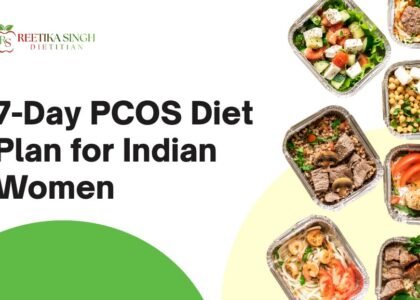
A Simple 1-Day PCOS Diet Plan – Indian Style
Want to see what an actual PCOS-friendly Indian day of eating looks like? Here is a sample:
Early Morning (6:30 – 7 AM)
Warm water with a pinch of cinnamon and methi seeds soaked overnight excellent for insulin sensitivity
Breakfast (8 – 9 AM)
2 moong dal cheela with mint chutney + 1 cup green tea
OR
Vegetable oats upma with a boiled egg
Mid Morning Snack (11 AM)
A small handful of mixed nuts- walnuts, almonds, pumpkin seeds
OR
1 seasonal fruit – guava, apple or pear
Lunch (1 – 2 PM)
2 whole wheat roti + 1 bowl dal + sabzi + 1 small bowl curd + salad
Evening Snack (4 – 5 PM)
Roasted chana or makhana
OR
1 cup green tea with a small piece of dark chocolate
Dinner (7 – 7:30 PM)
1 to 2 roti + light sabzi + 1 bowl dal OR a bowl of khichdi with vegetables
Bedtime (9:30 PM)
1 glass warm turmeric milk with a pinch of cinnamon
Lifestyle Tips That Work Alongside Diet
Diet alone is powerful but combined with these habits the results are even better:
Exercise regularly – You do not need an intense gym workout. Even 30 minutes of brisk walking daily significantly improves insulin sensitivity in PCOS. Yoga is particularly effective for hormonal balance.
Prioritize sleep – Poor sleep worsens insulin resistance and increases cortisol which directly aggravates PCOS. Aim for 7 to 8 hours every night.
Manage stress – Cortisol – the stress hormone – directly worsens PCOS. Meditation, deep breathing, journaling or even 10 minutes of quiet time daily makes a real difference.
Track your cycle – Use an app to track your periods. Sharing this data with your dietitian and doctor helps identify patterns and measure improvement.
How Long Does It Take to See Results?
This is always the first question my PCOS clients ask and I always give an honest answer.
Most women notice improvement in energy levels and bloating within 2 to 3 weeks of consistently following their diet plan.
Skin improvements – reduced acne and oiliness typically show within 4 to 6 weeks.
Period regularity – this takes longer and typically improves within 2 to 3 months of consistent diet and lifestyle changes.
Weight loss – with PCOS the scale moves slowly and that is completely normal. Focus on inches and how you feel not just the number on the scale.
Patience and consistency are everything with PCOS. There are no shortcuts but the results are absolutely real and lasting.
FAQ
Q: Can PCOS be cured permanently?
PCOS cannot be permanently cured but it can be very effectively managed through diet, lifestyle and where necessary medication. Many women with PCOS live completely normal healthy lives with the right management plan.
Q: I have PCOS and I am trying to conceive can diet help?
Yes absolutely. Improving insulin sensitivity through diet, achieving a healthy weight and balancing hormones through nutrition significantly improves fertility in women with PCOS. Always work with both your gynecologist and dietitian together for the best results.
Q: What is the best exercise for PCOS?
A combination of walking, yoga and strength training works best for PCOS. Avoid extremely intense cardio as it can increase cortisol and worsen hormonal imbalance. Start with 30 minutes of walking daily.
Q: Does stress really make PCOS worse?
Yes, significantly. Cortisol the stress hormone directly worsens insulin resistance and hormonal imbalance in PCOS. Stress management is as important as diet in PCOS management.
Q: Is it okay to eat rice with PCOS?
Yes, in controlled portions combined with dal, vegetables and protein. Choose smaller portions and always pair rice with fiber and protein to slow glucose absorption.
Q: How much does a PCOS diet consultation cost in Noida?
Plans start from ₹1499 for a 30-day personalized PCOS diet plan including weekly monitoring and WhatsApp support.
Q: Is online PCOS diet consultation available for Delhi clients?
Yes, complete online consultations are available for clients across Delhi, Noida and all of India via WhatsApp and phone.
Final Thoughts
PCOS and PCOD can feel overwhelming especially when you are dealing with weight gain, irregular periods, acne and fatigue all at once. But I want you to know something important.
You are not broken. Your body is just asking for the right support.
And the right diet is one of the most powerful forms of that support. I have seen women in my Noida & Delhi practice transform their health their periods, their skin, their weight, their energy through consistent, personalized nutrition.
It takes time. It takes patience. But it absolutely works.
You deserve to feel well in your own body. Let’s work on this together!